
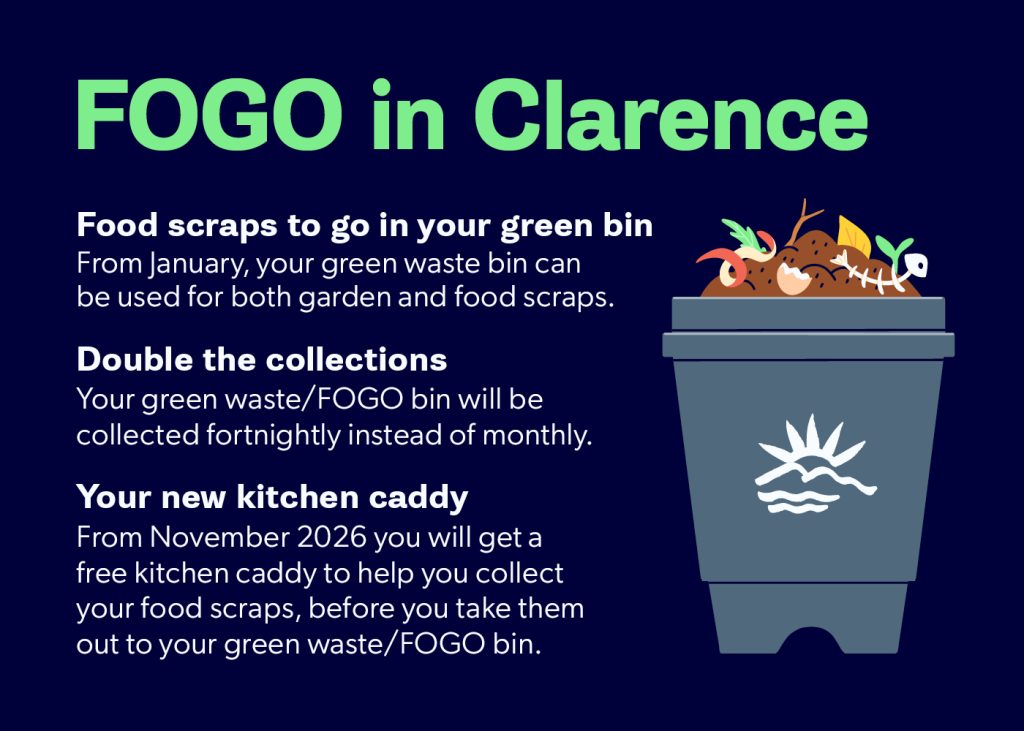
From January 2027, Clarence households with an existing green waste service will be able to dispose of food scraps and garden waste together through our new Food Organics Garden Organics (FOGO) service.
Your existing green waste bin will become your FOGO bin, helping turn everyday food scraps and garden waste into compost, instead of sending them to landfill.
The rollout of our new FOGO kerbside service is supported by our recent community engagement and what you told us in the FOGO, Waste and Litter Survey.
On this page you’ll find information about how the service works and what can go in your FOGO bin. If you have any questions or concerns, you can lodge them directly with us.
Your free kitchen caddy is on its way!
Throughout November and December 2026, we’ll deliver a kitchen caddy to every Clarence household with a green waste service. Your caddy is a 7-litre container that can sit on your benchtop, under the sink, or in any handy spot, making it easy to collect food scraps. Start collecting food scraps in your kitchen caddy, and emptying its contents into your FOGO bin, from January 2027.
When will I receive my kitchen caddy?
The delivery of kitchen caddies will begin in early-November 2026 and will continue through November and December. With more than 23,000 to deliver, the rollout will take some time. You should receive your caddy before the FOGO service starts in January 2027. If you do not receive a caddy before 4 January please submit a waste enquiry here:
You can also call us on 6217 9500.
Who receives a kitchen caddy?
Every Clarence household with a green waste bin will receive one free caddy. This includes units that share a communal green bin.
Commercial properties, schools, and other eligible premises with a green waste service can request a caddy using an online request form which will be available on this website in January.
How will I receive my caddy?
Caddies will be delivered during November and December. You will receive your caddy near your letterbox. For units, we’ll leave it at your front door.
I haven’t received my caddy yet. What should I do?
Deliveries will continue through December. If you have a green waste service and still haven’t received your caddy by 4 January, you will be able to request one using our online request form. The form will be available on this page at the end of the caddy rollout.
How do I use my caddy?
After your last green waste collection in 2026:
- Collect your food scraps in your caddy. See the list below: “What can go in your FOGO bin?”
- Empty the contents of your caddy into your green bin, ideally every 2–3 days, or more often in hot weather (you don’t need to wait until it’s full)
- Rinse and reuse. A quick rinse after emptying keeps your caddy clean. For a deeper clean, use warm soapy water and let it dry. The caddies are also dishwasher safe.
Does my caddy need a liner?
No, your caddy is designed to be used without one. If you’d like to line it, use a paper bag, newspaper or paper towel. This will make it easier to tip the scraps in your caddy into your FOGO bin.
Please don’t put compostable bin liners, or plastic bags in your FOGO bin.
Can I have an extra, bigger or smaller caddy?
We are providing one free kitchen caddy for each home, in one size. Extra caddies aren’t available to order or buy through City of Clarence. If you’d like a second or different-sized container, you could use an ice cream container, yoghurt tub, or any other bucket.
Tips for using your caddy
- Keep the lid closed to contain smells and keep pests out.
- Let hot food cool and drain excess liquid before adding it.
- Keep your caddy out of direct sunlight and away from heat.
- Sprinkle a little bicarbonate of soda in the base and add a paper towel to absorb moisture.
- Rinse your caddy after emptying. If it starts to smell, empty it, rinse it and let it dry fully.
- If you won’t be using it for a few days, leave it clean and dry with the lid open.
FOGO FAQs
What is FOGO?
FOGO stands for Food Organics and Garden Organics. It turns everyday food scraps and garden waste into compost instead of sending it to landfill, helping reduce waste and greenhouse gas emissions.
When is FOGO starting?
The service starts from January 2027.
From January, your green waste bin can be used for both garden organic waste as well as food waste – allowing you to recycle food scraps and garden waste together.
Once your green waste bin has been collected for the last time in 2026, you can start putting eligible food scraps in your bin. Your green waste bin becomes your FOGO bin.
Your last 2026 green waste bin collection date can be found by downloading the latest printable waste calendar.
You can also use our bin collection search to find your waste collection area (ie Lindisfarne North, Howrah South) and bin collection dates.
What can go in your FOGO bin?
YES
- Garden waste
- Fruit and vegetables (including citrus)
- Meat, seafood, bones and eggshells
- Dairy products
- Rice, pasta and bread
- Coffee grounds and loose tea leaves
- Leftover or out-of-date food (removed from packaging)
- Pizza boxes, paper towels, tissues and shredded paper
NO
- Plastic bags or cling wrap
- Biodegradable or compostable plastic
- Glass
- Cans and aluminium foil
- Tetra Paks
- Tea and coffee bags
- Nappies
- Rocks, soil, treated timber or building materials
- Pet waste or dead animals.
Will I have to get a new bin?
No. Your current green waste bin will become your FOGO bin.
You will get a free kitchen caddy to place in your kitchen to help manage your food scraps.
Will this change my bin collection day?
No. You will still put your bin out on the same day. The only change will be how often your FOGO bin is collected. Your FOGO bin (green lid) will now be collected every two weeks instead of only once a month. Your general waste (red lid) and recycling (yellow lid) remain as normal. Download your 2026/27 waste calendar.
The new schedule will look like:
Green waste/FOGO (green lid)
Every two weeks
Food scraps and garden waste
Recycling bin (yellow lid)
Every two weeks
Paper, bottles, cardboard etc.
General waste (red lid)
Weekly
Everything else that can’t
go in other bins
What happens to my FOGO waste?
FOGO material is processed into compost and soil products rather than being sent to landfill. This helps divert organic waste from landfill and return nutrients to the soil.
Adding food scraps to your green waste helps to create a more nutrient-rich compost.
I already compost at home. Do I need FOGO?
Home composting is a great way to reduce food and garden waste, and FOGO is designed to complement home composting, not replace it.
FOGO can accept materials that can be difficult to manage in some home compost systems, including meat, bones, dairy, seafood, citrus and bread. FOGO compliments your composting while also providing an option for larger or seasonal volumes of garden waste.
Can meat, bones, and dairy go in FOGO bin?
Yes. Unlike many home compost systems, meat, bones, seafood and dairy products, including cheese and yoghurt, can all go into your FOGO bin.
You can also put products containing wheat, rice, or yeast in your FOGO bin, which many people avoid putting in their home compost.
Can I use compostable bags?
No. Compostable plastic bags are not accepted in the FOGO service. You can use newspaper, paper towel, or paper bags to collect food scraps.
How do I avoid my bin smelling or attracting insects?
Food and garden waste can create smells as it breaks down, particularly during warm weather. You can reduce odours and help prevent maggots and other insects by:
- Layering your FOGO bin: Add lawn clippings, leaves, newspaper or cardboard between layers of food waste. These materials help absorb moisture and reduce odours.
- Keep meat and seafood scraps cold: Store meat and seafood scraps in the freezer until collection day, then place them in your FOGO bin.
- Wrap food scraps: Wrap meat and seafood scraps in newspaper or compostable paper before placing them in the bin.
- Keep the lid closed: A closed lid helps keep insects out and contains odours.
- Keep your bin in the shade: Keeping your bin cool can slow decomposition and reduce smells.
- Rinse your bin regularly: Hosing out your bin after collection helps remove food residue that can cause odours and attract insects.
- Put your bin out every collection day: Even if it isn’t full, regular collection helps prevent food waste from sitting in the bin for too long.
- Sprinkle a little bicarbonate of soda into the bin.
Maggots can occur in any bin containing food waste, particularly during warm weather. Following these steps can help reduce the likelihood of maggots and keep your bin fresher.
What happens if the wrong things are put into my FOGO bin?
Keeping unwanted materials out of your FOGO bin helps us produce a higher-quality end product.
We’ll provide clear information and support to help households understand what can and can’t go in the bin. You don’t need to be a FOGO expert from day one.
Will I have to pay for a FOGO service?
If you currently receive a green waste service, your 2026–27 rates notice already includes the transition to FOGO.
The $75.81 waste service charge covers six months of green waste collection and six months of FOGO collection, including collection and processing costs.
This is an increase of $20.10 compared with last year, due to contract cost increases and the change to fortnightly collections.
From 2027–28, your rates notice will show the FOGO service charge separately.
What about smaller properties?
FOGO is suitable for all types of properties. Even if you have little or no garden waste, you can use your FOGO bin for food scraps.
Why is City of Clarence introducing FOGO?
Around 57% of Clarence’s general waste collected through our kerbside service is organic material that would be able to go into a FOGO bin.
When food and garden waste goes to landfill it breaks down and contributes to greenhouse gas emissions. A FOGO service helps recover this valuable organic material so it can be turned into compost instead.
Introducing FOGO will:
- reduce landfill waste
- lower greenhouse gas emissions
- recover valuable organic material
- support a more sustainable future for Clarence.
I have more questions about FOGO. Who can I speak to?
If you have a question about the new FOGO service which we haven’t answered above, please contact our Waste and Sustainability team by emailing clarence@ccc.tas.gov.au or calling us on 6217 9500.
You can also submit a waste enquiry here: Waste enquiry online form