
Strengthening Communities. Building Resilience. Safeguarding futures.
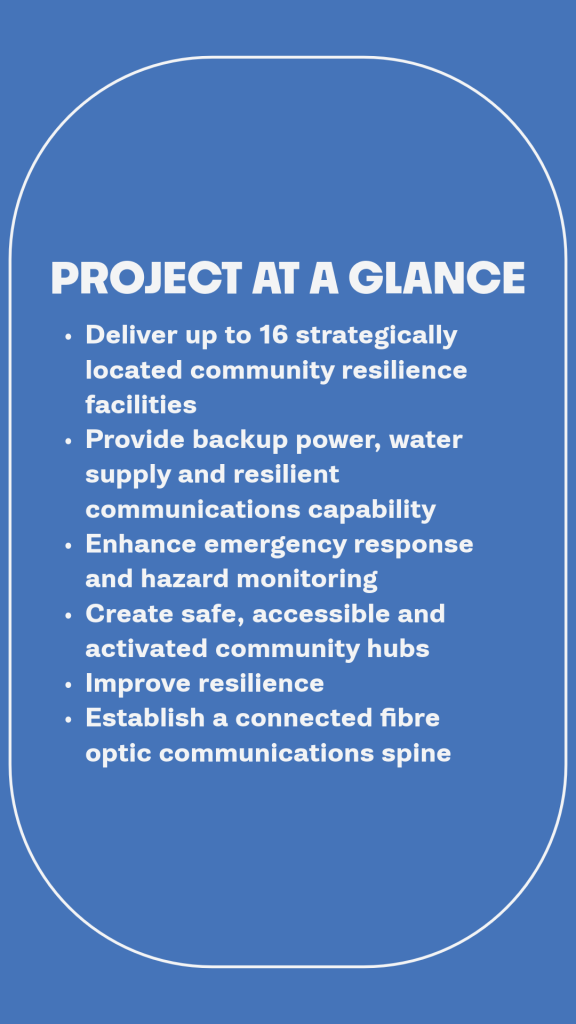
The Community Resilience and Safety Program will deliver up to 16 community resilience facilities across Clarence over the next 10 years to improve emergency preparedness and public safety. These facilities will provide essential infrastructure, including backup power, water, communications and safe community spaces to support response and recovery during emergencies.
Located across urban, rural and coastal communities, the resilience facilities will play an important role in supporting communities before, during and after emergency events including bushfires, severe storms, flooding and coastal inundation. In emergency situations, these facilities will provide safe and accessible locations where communities can access power, communications, information, and support services when traditional infrastructure may be disrupted.
Importantly, the program is designed to deliver long-term community value beyond emergency management. The resilience facilities will also function as welcoming, accessible and activated community hubs that support local programs, events, social connection and community wellbeing, helping strengthen social cohesion and local resilience across the municipality.
The program responds to increasing climate, environmental and emergency management challenges facing Clarence and the broader Greater Hobart region. Many of Clarence’s communities are geographically dispersed and vulnerable to isolation during emergency events, reinforcing the need for resilient local infrastructure and stronger emergency preparedness capabilities.
The Community Resilience and Safety Program will be delivered in stages, commencing with the establishment and upgrading of resilience facilities in priority communities. Future stages will progressively expand a connected fibre optic communication backbone to support reliable emergency communications, real-time monitoring capability, facility connectivity and improved operational resilience across the network.
This staged approach allows council to progressively build a connected and resilient community infrastructure network while aligning delivery with broader infrastructure investment opportunities and long-term strategic priorities.
The program aligns strongly with the National Strategy for Disaster Resilience (NSDR), the National Climate Resilience and Adaption Strategy 2021-2025, the Tasmanian Disaster Resilience Strategy 2020-2025, the City of Clarence Strategic Plan 2025-2035 and Digital Strategy 2022-2032.


Social Benefits
The Community Resilience and Safety Program will deliver long-term social infrastructure that supports safer, more connected and accessible communities across Clarence. The program will enhance community safety and amenity through upgraded lighting, CCTV and integrated hazard monitoring systems around community facilities, parks, playgrounds and other key public spaces.
Improved access and management systems for halls and community facilities will also support more efficient and accessible use of shared community infrastructure for local groups and residents. Importantly, the program strengthens the municipality’s capacity to support vulnerable communities during emergencies while also creating activated and welcoming spaces that support community participation, connection and wellbeing year-round.
Economic Benefits
The Community Resilience and Safety Program will deliver long-term economic benefits through improved infrastructure resilience, reduced operational costs and more efficient management of community facilities and public assets. Investment in resilient infrastructure, integrated monitoring systems and improved facility management technology will help reduce vandalism, asset damage and maintenance costs while supporting more efficient service delivery and long-term asset management outcomes.
The program will also strengthen Clarence’s disaster preparedness and recovery capability, helping reduce the long-term economic impacts associated with emergency response, infrastructure disruption and recovery efforts. By activating community hubs and improving local infrastructure, the program will support increased community participation, local economic activity and broader place-based outcomes that contribute to Clarence’s attractiveness as a place to live, work and invest. Importantly, the staged delivery approach allows Council to integrate infrastructure investment with future capital works programs and broader strategic infrastructure planning to maximise long term value and cost efficiency.
Why Invest?
- Safer and more resilient communities
Strengthen local emergency preparedness, response and recovery capabilities through resilient community infrastructure, backup power and water systems, improved communications, and enhanced hazard monitoring. - Safe and accessible community spaces
Deliver welcoming, accessible and resilient community facilities that provide safe places for people to gather, connect and access support services during both everyday community activities and emergency events. - Supporting vulnerable and isolated communities
Provide strategically located resilience facilities across urban, rural and coastal communities to support access to essential services and emergency support during disaster events. - Climate adaption and disaster preparedness
Improve the municipality’s capacity to respond to increasing climate-related risks including bushfires, severe storms, flooding and coastal inundation. - Connected and activated community hubs
Create multi-purpose community hubs that support local programs, events, social connection and community wellbeing, strengthening social cohesion and local resilience across the municipality. - Long-term infrastructure resilience
Establish resilient communications infrastructure and integration monitoring systems that improve operational reliability, emergency coordination and long-term service delivery outcomes. - Smarter and more efficient service delivery
Improve facility management, asset monitoring, and operational efficiency through integrated infrastructure systems that support better long-term management of Council assets and community facilities.
| Total Project Cost | $5.5m |
| Funding Sought | $3.7m |
| Project Timeline | Stage one: Establishment of Community Resilience Facilities ($3.7million) Stage One focuses on the establishment and upgrading of up to 16 strategically located community resilience facilities across the municipality. Stage two and three – Fibre Optic Spine ($1.8million) Stage Two and Three will progressively expand a connected fibre optic communications spine linking the resilience facilities across Clarence. |